
How Deep-Tech Startups Are Transforming India
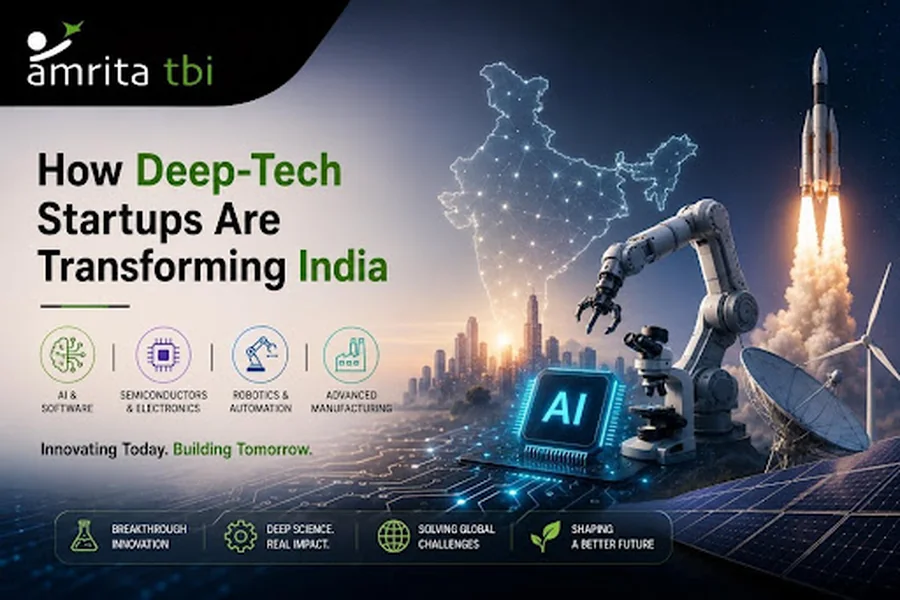
For years, India’s startup narrative has been dominated by apps – fintech, food delivery, e-commerce, and edtech platforms transforming how services reach millions. But a new chapter is emerging. Deep-tech startups focused on AI, semiconductors, robotics, electronics, and advanced manufacturing are redefining what’s possible, shifting the focus from digital distribution to breakthrough innovation. At Amrita TBI, we’re proud to support founders building technologies that solve complex global challenges and shape the future of innovation.
What “Deep-Tech” Actually Means
Deep-tech startups are companies built around genuine scientific or engineering breakthroughs, rather than a new interface on an existing service. Electronic design and manufacturing, deep-tech software and product engineering, and advanced ICT infrastructure are the kinds of categories that fall under this umbrella – work that typically requires longer R&D timelines, more capital-intensive prototyping, and technical expertise that’s harder to hire for than a typical software team.
That difficulty is exactly why deep-tech has historically been underrepresented in Indian entrepreneurship. Building a food delivery app requires a strong team and market timing. Building a functioning hardware prototype requires lab access, specialized components, patient capital, and mentors who’ve actually solved similar engineering problems before – resources that have simply been scarcer in India’s startup ecosystem.
Why the Shift Is Happening Now
Three things have converged to make deep-tech entrepreneurship more viable in India than it’s ever been.
Government policy has caught up. Programs like MeitY’s GENESIS scheme (Gen-Next Support for Innovative Startups) represent a deliberate, well-funded bet on this shift. GENESIS runs with a budget of Rs 490 crore over five years, aimed at discovering, supporting, and accelerating startups specifically in Tier-II and Tier-III cities – explicitly targeting sectors like electronic design and manufacturing, deep-tech software and product, and the broader ICT space. The scheme’s ambition is large: consolidating and impacting over 10,000 tech startups over five years, with an emphasis on inclusive growth rather than concentrating opportunity in a handful of metro hubs.
Incubators are building real infrastructure, not just office space. Deep-tech founders need things a typical co-working space can’t offer – fabrication labs, prototyping equipment, and access to engineering talent. Amrita Technology Business Incubator (Amrita TBI), one of the select implementing agencies for the MeitY Startup Hub, pairs its GENESIS programs with a Fab Lab offering 3D printing, PCB design, IoT tooling, and CNC machining – the kind of resource that has, until recently, only really existed inside a handful of university engineering departments in India.
Funding is finally matching the R&D timeline deep-tech actually needs. Software startups can often reach a testable product in months. Deep-tech founders frequently need a year or more just to reach a working prototype. Recognizing this, MeitY’s GENESIS EIR program – implemented through Amrita TBI – provides a subsistence grant of up to Rs 10,00,000 per year to an aspiring entrepreneur pursuing a promising technology business idea, with no matching fund requirement. That detail matters: a lot of government schemes ask founders to bring co-investment they don’t yet have. GENESIS EIR removes that barrier specifically so early-stage deep-tech founders can commit full-time to an idea before it’s proven enough to attract private capital.
What This Support Actually Looks Like in Practice
The GENESIS EIR program, as implemented by Amrita TBI, is built around a few concrete eligibility principles worth understanding, because they reveal what the scheme is actually trying to select for:
1. The founder must be a first-generation entrepreneur committing full-time to the idea during the program
2. The startup must be in ideation, validation, or very early stages, and must not have already received more than Rs 10 lakh in external funding, including other government grants
3. The idea must align with GENESIS’s core sectors: electronic design and manufacturing, deep-tech software and product, or ICT
4. The startup must show real potential for scalability and impact, particularly in Tier-II and Tier-III cities
5.If already incorporated, the entity must be a Private Limited Company or LLP, and no older than two years
Beyond the grant itself, recipients get mentorship and handholding across mentoring sessions, market and customer connections, IPR support, and fundraising support – recognition that deep-tech founders often need help not just building the technology, but protecting it and eventually selling it to a market that may not yet understand why it matters.
It’s also a program with real accountability built in. GENESIS EIRs are monitored closely against milestones, required to submit progress reports, and non-performing recipients can be terminated before completing 12 months. That’s a deliberate design choice – it keeps the program focused on founders who are genuinely building, not just holding a grant.
The Proof Is Already in the Portfolio
Amrita TBI’s own track record gives a preview of what this kind of support can produce. Yellow Messenger, an Amrita TBI-incubated company, built a conversational AI-driven platform that deployed voice bots for more than 700 companies, including Amazon, before using follow-on funding to expand into the U.S. market. MiQasa Home Automation, another Amrita TBI startup, won “The Emerging Tech Startup of the Year” from Entrepreneur Magazine India and was later acquired by Smartron, backed by Sachin Tendulkar. These aren’t app-layer businesses – they’re companies built on real technical depth, incubated inside a system that gave them lab access, patient funding, and mentors who understood what they were actually building.
Why This Matters Beyond Any Single Startup
The transformation deep-tech represents for India isn’t just about a few high-profile companies – it’s about what kind of economy the startup ecosystem is capable of building. Software startups largely compete on execution speed and market reach. Deep-tech startups compete on genuine intellectual property: patents, proprietary hardware, defensible engineering advantages that are much harder for a competitor to simply copy. A startup ecosystem that can consistently produce deep-tech companies is one that’s building durable, exportable technological capability – not just apps that solve local distribution problems.
It’s also an ecosystem that reaches further geographically. GENESIS’s explicit focus on Tier-II and Tier-III cities reflects a recognition that deep-tech talent isn’t confined to Bengaluru and Delhi-NCR. Engineering colleges across the country produce founders capable of this kind of work; what’s been missing is the infrastructure and patient capital to let that talent build something real instead of moving to a metro to join someone else’s company.
The Road Ahead
Deep-tech entrepreneurship in India is still young relative to the country’s software startup ecosystem, and the challenges are real – longer timelines, higher technical risk, and a funding ecosystem still calibrated more for software speed than hardware patience. But the infrastructure to change that is being built deliberately: government schemes like GENESIS with real budgets and real sector focus, incubators like Amrita TBI providing the lab access and mentorship deep-tech founders actually need, and a growing portfolio of companies proving the model works.
If India’s first startup decade was about building apps for a billion people, the next one increasingly looks like it will be about building the technology those apps – and a great deal else – eventually run on.
Amrita TBI is a select implementing agency for the MeitY Startup Hub GENESIS scheme, supporting deep-tech and technology entrepreneurs through its EIR program and Fab Lab infrastructure. Details are available at amritatbi.com/meity-startup-hub-genesis-eir.html.